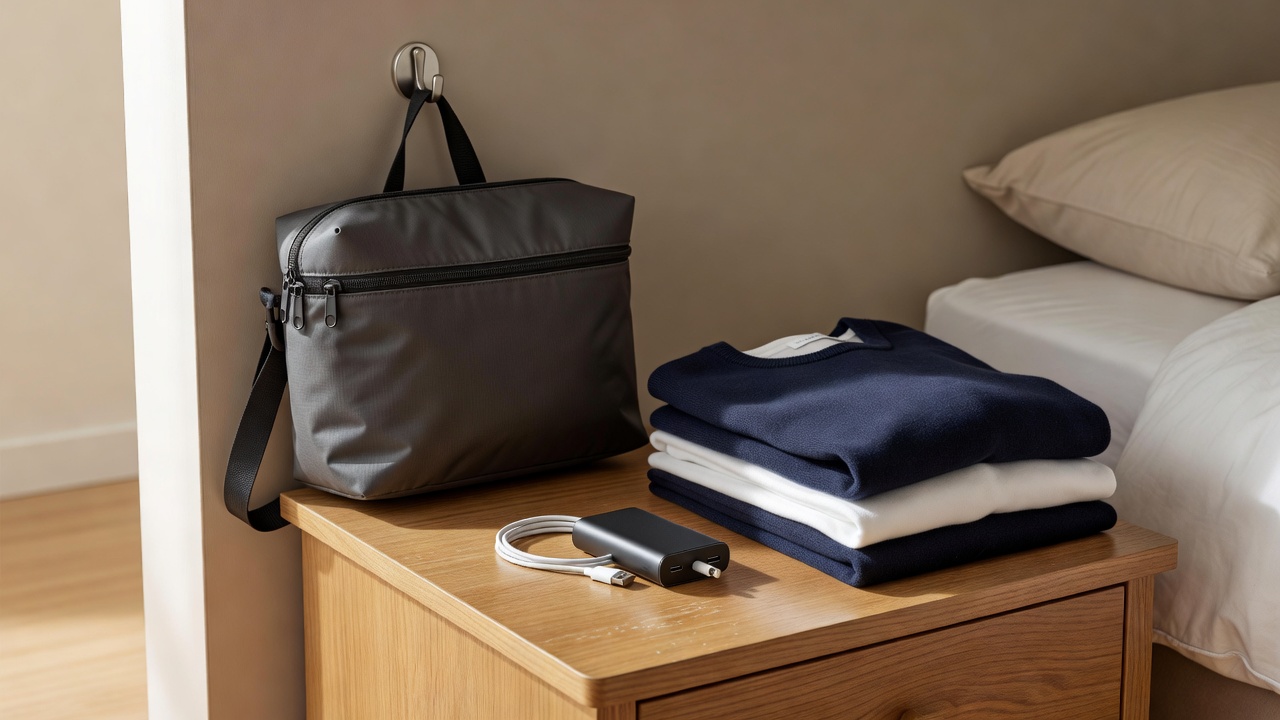
Create a landing place
On arrival, choose one sensible place for the items you tend to mislay: room key, glasses and the pouch you used in transit. A small folding tray can help on a busy desk, but an existing zipped pouch often does the same job. Do not spread valuable belongings across several drawers simply because the storage is available.
Unpack according to the length of your stay. For one night, removing a washbag and the next outfit may be enough. For a longer visit, a few packing cubes can act as drawer organisers without adding separate equipment. Keep dirty clothing distinct from clean items, and avoid placing bags where they block the door or a walkway.
Check the accommodation description before buying “just in case” essentials. A towel, hairdryer, kettle or laundry service may already be available. Ask about anything important rather than assuming a photograph proves it is included. Booking categories are not universal: a private room, hostel bed and self-catering apartment can provide very different facilities.
Match the electricity, not just the socket
A plug adapter changes the physical connection. It does not, by itself, convert voltage or frequency. Read the input label on each device and compare it with the destination supply. Many modern electronics accept a range of inputs, but that is not a safe assumption for every appliance. Heated devices deserve particular care because their power demand can be high.
A universal adapter may cover several plug shapes, but it can be heavier and less stable than a suitable single-destination adapter. Check its electrical rating, grounding arrangement and instructions. Do not defeat earth connections, force a loose fit or stack adapters into an unstable assembly. A charger placed on a bed or beneath clothing can also lose the ventilation it needs.
Electrical Safety First’s travel-adapter guidance and the International Electrotechnical Commission’s World Plugs resource are useful references. Your device label, product instructions and destination-specific information remain essential. If you are unsure whether equipment is compatible, do not use trial and error as the test.
| Check | Question to answer |
|---|---|
| Plug shape | Does the adapter suit the socket and your plug? |
| Input rating | Does the device support the local voltage and frequency? |
| Load and earth | Is the adapter appropriately rated and grounded where required? |
| Placement | Is the connection secure, dry and unobstructed? |
Make washing and drying realistic
A hanging washbag is helpful where counter space is scarce, provided there is a suitable place to hang it. Check that the hook supports the loaded bag and does not damage a fitting. A wide organiser may look tidy when open but become surprisingly bulky once bottles are inside. Smooth, accessible compartments are easier to wipe than many narrow elastic pockets.
A compact towel can earn its place in hostels, on swimming days or where towels are not supplied. It still needs somewhere to dry. Compare the packed size with the drying area available, and wash it according to the care label. For an ordinary hotel stay with suitable towels included, bringing another one may only create laundry.
Handwashing a few garments can reduce how much clothing you need, but it requires time, permission and ventilation. Check property rules before using a travel clothesline or washing in a basin. Do not attach lines to sprinklers, electrical fittings or fragile furniture. A garment that dries slowly at home may stay damp even longer in a humid room.
Avoid turning arrival into installation
Door accessories, portable alarms and travel appliances can introduce new problems as well as solving old ones. A door device may not fit the lock, may conflict with accommodation rules or may impede emergency access. Do not rely on it as a security guarantee. Inspect the room, understand the exits and raise concerns with the property instead.
Portable kettles, steamers and cooking devices may be prohibited or unsuitable for the electrical supply. Ask before bringing them. If the need is simply a hot drink, a shared kitchen or an available kettle may be the less complicated answer. Check cleanliness and instructions rather than treating any provided appliance as automatically ready to use.
Before leaving, reverse your arrival routine. Check sockets, bathroom hooks, the bedside area and wherever your laundry dried. Let damp items dry where possible before closing the bag. A short, repeatable sweep is useful precisely because it needs no extra product. The aim is a room that works for your stay, not a temporary installation you must dismantle.
Electrical compatibility and accommodation policies vary. Follow product instructions, confirm the local supply and ask your property about restrictions before using additional appliances or fittings.