Let the bag set the limits
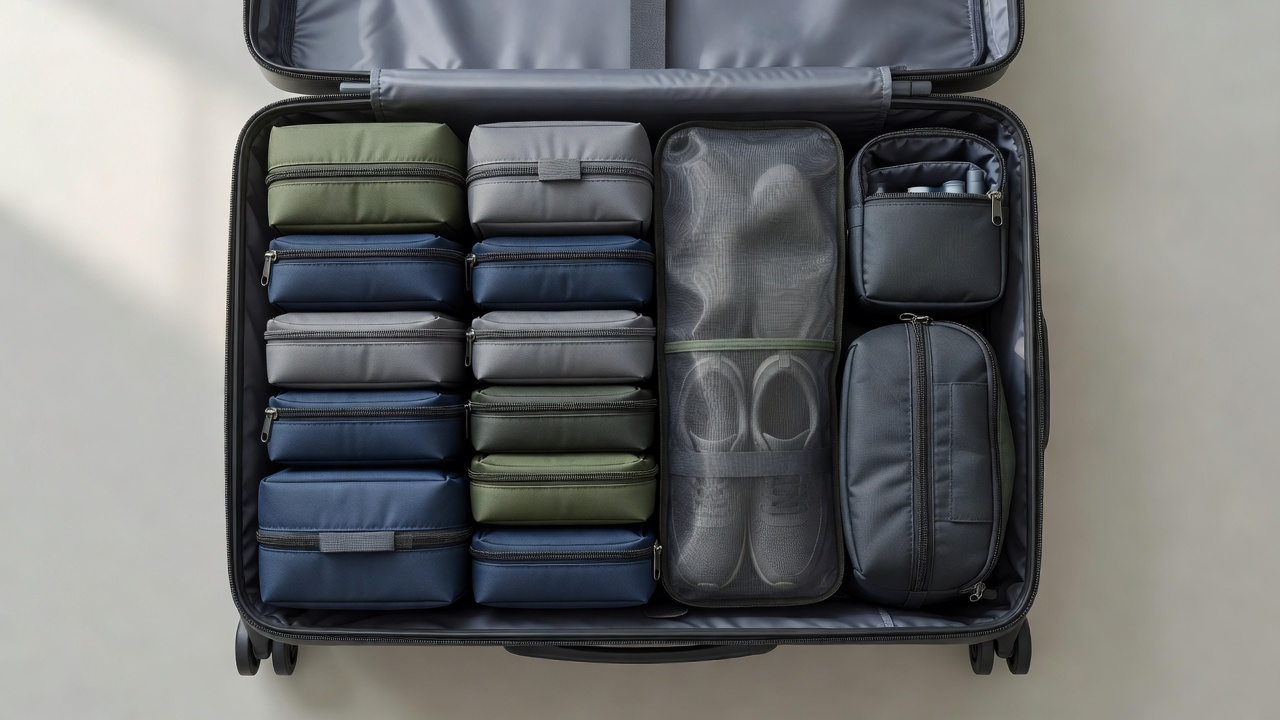
Before choosing packing cubes, empty the bag you actually intend to take. Notice the wheel housing, curved corners, internal pockets and opening. A cube that fits the published external measurements may not sit flat inside. With a top-loading backpack, several short pouches can be easier to retrieve than one large rectangular block.
Make a trial pack using your real clothes and footwear. Close the bag without leaning on it, lift it, and carry it for a few minutes. Leave some space for clothing that will not be folded as neatly on the way home. Compression can reduce the volume of soft items, but it does not reduce their weight or make a heavy bag easier to lift.
A luggage scale can help if you regularly travel near an operator’s weight limit. It is not a substitute for checking dimensions or accounting for measurement differences. Compare the allowance on your exact booking: Ryanair, easyJet and British Airways offer different bag options, and fares and operating carriers matter.
Give each pouch a clear job
Packing cubes work well when they divide a broad category you would otherwise rummage through: underwear, evening clothing or a child’s spare outfit. They work less well when each small object receives its own container. Every extra zip creates another step, and a collection of rigid organisers can waste the flexible spaces between larger items.
Look for smooth zip operation, seams that are easy to inspect and fabric that can be cleaned according to the care instructions. Mesh panels make contents visible but offer little protection from spills. Compression cubes add a second zip and may form dense, uneven blocks. Try an ordinary fabric cube first if finding things, rather than reducing volume, is the actual problem.
Run the existing-item test
- Use a clean drawstring bag for socks or underwear.
- Keep shoes in a washable bag already at home.
- Put one complete outfit together for the first night.
- Remove any container whose purpose you cannot explain.
Contain liquids without guessing
Refillable bottles are useful when a large retail container holds much more than you need. Check material compatibility: oils, alcohol-based products and concentrated toiletries may not suit every bottle. Label the contents, test the closure at home, and leave any expansion space recommended by the container manufacturer. A separate washable pouch offers another layer of containment, not a guarantee against leaks.
Consider a solid product only if you already know it suits your skin or hair. A wet shampoo bar needs to drain and dry; sealing it immediately in a tight tin can leave it soft and messy. A familiar small original container can be the simpler option, particularly when its label contains instructions you need.
Airport liquid screening is a separate question. Check the departure and transfer airports, not just your destination. Transportation Security Administration guidance covers United States screening, while GOV.UK guidance explains UK restrictions and exceptions. Equipment and procedures vary; a bag described as “airport approved” does not establish acceptance everywhere.
Plan for the untidy return
A laundry bag stops worn clothing from becoming mixed into clean outfits, but a waterproof sack can also trap moisture and odour. Separate damp swimwear only for the time needed to transport it, then unpack and dry it promptly. Choose a bag that can be washed, turned inside out and dried completely before storage.
Pack by the next action rather than by perfect symmetry. Keep the first-night washbag accessible, place rarely needed items deeper in the case, and avoid hiding medication behind several organisers. Carry necessary medicines with appropriate identification and documentation; entry requirements can differ by country and substance.
Finally, repeat the packing exercise without the accessory you are considering. If the bag is still orderly and the item is easy to find, you may not need to buy anything. The useful result is a system you can maintain, not the largest possible collection of matching pouches.
| Tool | Helps with | Trade-off |
|---|---|---|
| Soft cube | Grouping clothing | Extra fabric and a zip |
| Compression cube | Bulky, compressible layers | Denser load; unchanged weight |
| Laundry pouch | Separating worn items | Damp contents still need drying |
| Luggage scale | Checking an approximate packed weight | Does not measure size or ensure acceptance |
Rule references are starting points, not a statement of acceptance for a particular trip. Recheck your booking, airports and destination before departure. We have not laboratory-tested the product categories described.